
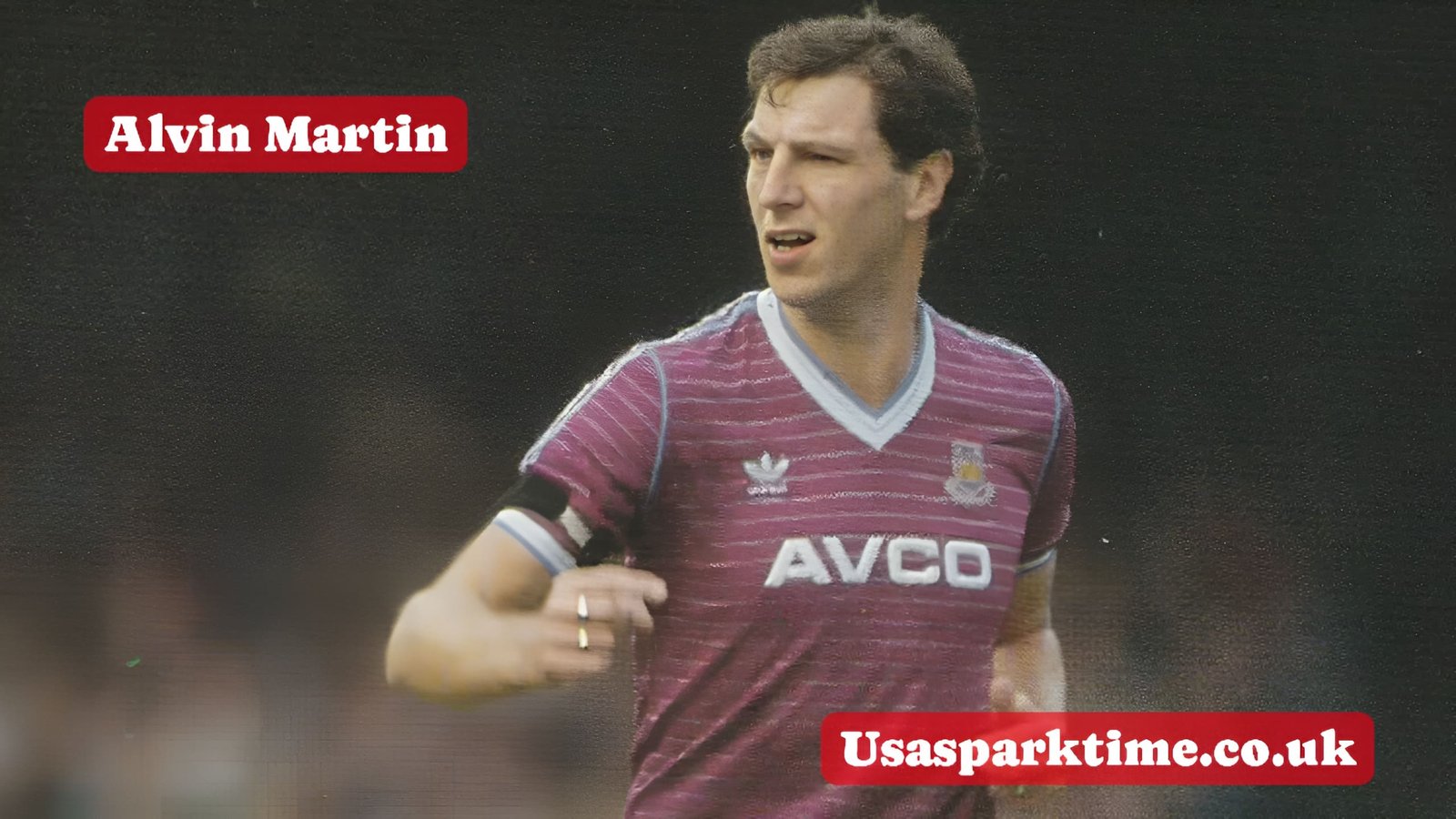
Alvin Martin is a former English professional footballer born on 29 July 1958 in Walton, Liverpool. A loyal one-club defender, he made 598 appearances for West Ham United across 21 years, won the 1980 FA Cup, earned 17 England caps, represented the country at the 1986 World Cup, and scored a unique hat-trick against three different goalkeepers in a single match. Post-retirement, he became a respected pundit on talkSPORT and Sky Sports.
Alvin Martin stands as one of English football’s most loyal and dependable defenders. Born in Liverpool in 1958, he rejected a part-time offer from Everton and instead joined West Ham United in 1974, where he spent the next 21 years of his professional life. Over nearly 600 appearances at Upton Park, Martin won the FA Cup in 1980, the Second Division title in 1981, and helped West Ham to an incredible third-place finish in the First Division in 1985-86. He also earned 17 caps for England and featured at the 1986 FIFA World Cup in Mexico. Perhaps his most iconic moment came on 21 April 1986, when he scored a hat-trick against three different Newcastle United goalkeepers in an 8-1 victory — a feat unique in football history. After retiring, Martin seamlessly transitioned into media, becoming a trusted voice on talkSPORT radio and Sky Sports. His sons David and Joe both became professional footballers, cementing the Martin family’s lasting contribution to English football.
| Alvin Martin — Quick Bio Table | |
| Full Name | Alvin Edward Martin |
| Date of Birth | 29 July 1958 |
| Place of Birth | Walton, Liverpool, England |
| Nationality | English |
| Position | Centre-Back / Defender |
| Club Career | West Ham United (1974–1996), Leyton Orient (1996–97) |
| Appearances | 598 (West Ham United) |
| Goals | 34 (West Ham United) |
| International | 17 caps for England (1981–1986) |
| Major Honours | FA Cup 1980, Second Division Title 1981, 1986 World Cup |
| Nickname | ‘Stretch’ |
| Post-Career | Manager (Southend United), Pundit (talkSPORT, Sky Sports) |
| Net Worth | ~$5 Million (est.) |
| Sons | David Martin (goalkeeper), Joe Martin (defender) |
Introducing: Who Is Alvin Martin?
The Man Behind the Legend
Alvin Edward Martin is one of English football’s most celebrated and enduringly respected figures. Born on 29 July 1958 in Walton, Liverpool, he grew into a centre-back of extraordinary composure, intelligence, and loyalty. While Liverpool was a city famous for its own clubs, young Martin was destined for the claret and blue of West Ham United — a club he would serve with singular dedication for over two decades, making him a symbol of loyalty in an era that would slowly forget what that word meant.
A Boy from Merseyside with a London Destiny
Growing up in the football-mad streets of Merseyside, Martin played school football for Bootle and Lancashire and caught the eye of Everton as a schoolboy. However, Everton’s offer of only a part-time apprenticeship failed to match his ambitions. A brief trial at QPR also ended inconclusively. It was Ron Greenwood at West Ham United who recognised his potential and offered him a proper apprenticeship in 1974. That decision changed Martin’s life and ultimately shaped the history of West Ham United’s backline for two extraordinary decades.
Why His Story Still Matters Today
In the modern game, where players move clubs every two or three seasons seeking higher wages, Alvin Martin’s story stands as a powerful counter-narrative. He stayed with West Ham through relegation, promotion, league highs and personal lows — embodying exactly what it means to be a true club servant. His story resonates not just with West Ham fans but with football lovers across generations who believe that loyalty, consistency, and character are qualities that define the greatest players more than trophies alone ever could.
Early Life and Football Formation
Childhood in a Football-Loving City
Liverpool in the late 1960s and early 1970s was a city breathing football from every corner. Though Everton and Liverpool FC dominated local conversations, young Alvin Martin was carving his own path on the school pitches of Bootle and Lancashire. He displayed a natural ability to read the game, command his defensive area, and lead teammates — qualities that went far beyond simple athletic ability. His parents, though private, encouraged his passion, and Martin dedicated himself to improving every single day, understanding even then that professional football demanded discipline as much as talent.
Rejection as Fuel: The Everton Setback
Everton’s scouts had noticed Martin’s talent and attached him to their schoolboy setup. Yet when the club only offered a part-time apprenticeship, Martin refused to settle for less than full commitment. That rejection — if one can call it that — became the defining fuel of his career. He turned to QPR for trials next, but they too remained undecided. Rather than despair, Martin went on a two-week trial at West Ham United, where Ron Greenwood quickly recognised what others had overlooked and offered him a full apprenticeship. Rejection, in Martin’s case, simply redirected destiny.
Also read this: Jayson Christopher Tatum Jr.: The NBA’s Most Famous Little Champion
Joining West Ham: The Apprenticeship Begins
In August 1974, Alvin Martin officially became a West Ham United apprentice. The club’s famed Academy of Football, under Ron Greenwood, was already producing some of England’s finest talents, and Martin arrived at the perfect environment to grow. He played in the FA Youth Cup final in 1975, honing his skills alongside future professionals. He signed his first professional contract on 29 July 1976, his 18th birthday. His first-team debut came nearly two years later — as a substitute away at Aston Villa in March 1978 — the start of one of English football’s most remarkable one-club careers.
Building a Legacy at West Ham United
The Early Years: Learning the Craft
Martin’s first full season in 1977–78 was actually West Ham’s relegation year, and he made only five appearances. Yet rather than lose faith, he embraced the challenge of Second Division football, using it to cement his place in the squad. Playing in the lower tier turned out to be no obstacle — indeed, it forged the character that would define his career. Alongside Billy Bonds — who became his long-term defensive partner and close friend — Martin began developing into one of the most reliable centre-backs in English football, combining positional intelligence with physical robustness and natural leadership.
The 1980 FA Cup Triumph: A Defining Moment
The 1979–80 season delivered Alvin Martin’s first major honour. West Ham United, still a Second Division club at the time, produced one of the great FA Cup runs and met Arsenal in the final at Wembley. In a stunning 1-0 victory, the Hammers became the last second-tier side in history to win the famous cup competition. Martin, just 21 years old, played a crucial role throughout the tournament. Winning the FA Cup while competing a division below the opponents exemplified the spirit and quality of that West Ham squad — and Martin was at the heart of it all, growing with every game he played.
The 1981 Second Division Title and Back to the Top
Building on the FA Cup glory, West Ham won the Second Division title in 1980–81, returning to the top flight. Martin was central to the team’s defensive solidity throughout that campaign. Playing in the second tier had never diminished his quality; if anything, it had sharpened it. Ron Greenwood — who had by now become the England manager — was watching closely and was so impressed by Martin’s form that he selected him for the national team despite the fact Martin was still technically playing Second Division football. That kind of recognition from an international manager is perhaps the clearest possible endorsement of his exceptional quality during this period.
International Career: Representing England with Pride
England Debut: Against Brazil at Wembley
Alvin Martin received his first England cap from Ron Greenwood in May 1981, selected to face Brazil at Wembley — arguably one of the most prestigious international fixtures in English football. The fact that Martin was playing Second Division football at the time made the call-up all the more remarkable. It was Greenwood’s way of saying that talent and character outweighed league status. Martin responded with a composed, assured performance that convinced doubters and confirmed what West Ham fans had known for years: this was a defender capable of competing at the very highest level of the sport without ever looking out of place.
The Cruel Blow: Missing the 1982 World Cup
As England prepared for the 1982 FIFA World Cup in Spain, Martin was considered a strong candidate for the squad. His form in the First Division had been consistently excellent. But injury cruelly intervened, ruling him out of the tournament entirely. Missing a World Cup through no fault of your own is among the bitterest experiences any professional footballer can endure. Martin handled the disappointment with the same quiet resilience that characterised his entire career — he returned to training, worked harder, and bided his time for the next opportunity to prove himself on the international stage, which came four years later.
Mexico 1986: World Cup Glory and the Hand of God
Bobby Robson included Martin in England’s squad for the 1986 FIFA World Cup in Mexico, giving him his long-awaited chance on football’s biggest stage. He featured in the victory over Paraguay, replacing the suspended Terry Fenwick, and performed with his trademark calmness. Robson’s decision to omit him from the famous quarter-final against Argentina — the match in which Diego Maradona scored the ‘Hand of God’ goal — meant Martin watched from the sidelines as England exited the tournament. In total, he earned 17 caps for England, a respectable tally that would likely have been higher had injuries and competition for places been less severe.
The Historic Hat-Trick: A Moment for the Ages
April 21, 1986: When Football History Was Made
On 21 April 1986, during West Ham’s remarkable 1985–86 season, Alvin Martin achieved something that no other player has replicated in the history of professional football. In a First Division match against Newcastle United — which West Ham won 8–1 — Martin scored a hat-trick, but the extraordinary detail that made it truly unique was that each goal was scored against a different goalkeeper. Newcastle’s first goalkeeper, Martin Thomas, was injured during the match. Outfield player Chris Hedworth took over in goal, then Peter Beardsley — later to become one of England’s most celebrated forwards — also had to step between the posts.
Three Goalkeepers, One Hat-Trick, One Legend
The statistical probability of scoring a hat-trick against three different goalkeepers in a single professional football match is so astronomically small that football historians believe it may never happen again. Martin’s goals were not scrambled or fortunate — they were taken with the composure and technique of a man who had spent years perfecting every aspect of his game. The 8–1 scoreline itself was historic, with West Ham tearing through a Newcastle side that ran out of goalkeepers. But Martin’s hat-trick was the crowning jewel of the afternoon, a moment that football fans still discuss with genuine wonder and delight nearly four decades later.
The Season That Nearly Won the Title
The 1985–86 campaign was arguably the finest collective season in West Ham United’s history. The club finished third in the First Division — just four points behind champions Liverpool — and Martin played in 40 of the 42 league matches, a testament to his fitness, consistency, and importance to the team. The Newcastle hat-trick came in the middle of this exceptional run of form. While West Ham ultimately fell short of the title, their third-place finish remains the club’s best-ever league position, and Martin’s contribution was absolutely central to that achievement. He had reached the peak of his powers at exactly the right moment.
Loyalty, Relegation, and the True Meaning of Commitment
Staying Down: The 1989 Relegation Season
When West Ham were relegated from the First Division in 1989, many of their key players departed. Alvin Martin stayed. That decision spoke more eloquently about his character than any goal or award ever could. He had options — clubs at the top flight would have taken him — but his commitment to West Ham ran too deep to abandon them in their hour of need. This was not naive sentimentality; it was principled loyalty rooted in genuine love for the club. He helped guide the team through the Second Division and celebrated their promotion back to the top flight in 1991, having never wavered in his dedication to the claret and blue shirt.
Two Testimonials: An Honour Reserved for the Truly Great
West Ham United awarded Alvin Martin two testimonial matches during his career — a distinction shared only by the legendary Billy Bonds among the club’s all-time players. The first testimonial was held against Tottenham Hotspur on 21 August 1988, and the second against Chelsea on 11 November 1995. Testimonials are among football’s most sincere forms of recognition — they are not handed out to ordinary players but reserved for those who have given extraordinary service over many years. That Martin earned two is simply extraordinary and speaks to the unique bond he built with supporters over more than two decades at Upton Park.
Final Years and Farewell to Upton Park
Alvin Martin spent three seasons in the newly formed Premier League before finally bringing his West Ham career to a close in May 1996, aged 37. His final game was a 1–1 draw at home against Sheffield Wednesday. He left with 598 appearances and 34 goals — remarkable numbers for a centre-back who was never selected primarily for his attacking contributions. After departing West Ham, he had a brief stint with neighbouring Leyton Orient before retiring from playing altogether. His farewell from Upton Park was emotional and deeply felt — a crowd saying goodbye not just to a footballer, but to a friend who had given them 21 years of pride and passion.
Life After Playing: Management, Media, and Family
Management at Southend United
Following retirement from playing, Alvin Martin moved into football management, taking charge of Southend United in 1997. He spent approximately two years at Roots Hall, working hard to apply the tactical intelligence and leadership qualities that had defined his playing career. Management is a different discipline entirely — the ability to play brilliantly does not automatically translate into the ability to coach and motivate others effectively — but Martin approached the challenge with the same work ethic that had carried him through his playing days. Though his managerial stint was relatively brief, it gave him valuable experience and deepened his understanding of the game from a completely different perspective.
The Media Voice: talkSPORT and Sky Sports
After management, Alvin Martin found his true post-career calling in the media. He became a regular presence on talkSPORT radio, where his deep knowledge of the game, clear communication style, and genuine passion for football made him an immediate favourite with listeners. He also established himself as a pundit on Sky Sports football programmes, where his measured, intelligent analysis offered viewers real insight into the tactical and human aspects of the modern game. Unlike pundits who thrive on controversy, Martin’s style was authoritative without being sensational — he spoke from decades of lived experience, and audiences trusted him instinctively because of it.
Family Legacy: The Martin Football Dynasty
Alvin Martin’s legacy extends beautifully into the next generation through his sons. David Martin, born in 1986, became a professional goalkeeper, notably playing for West Ham United and creating the touching moment of a father-son duo who both represented the same club at the top level. David later moved into coaching as a goalkeeping coach for Chelsea’s youth academy. Joe Martin, born in 1988, also played professionally as a defender in England’s lower leagues. The fact that both of Alvin’s sons followed him into the game is a powerful testament to the football values — hard work, discipline, and love for the sport — that he instilled in his family.
Conclusion
Alvin Martin’s life in football is a story worth telling, retelling, and remembering. From a rejected Everton schoolboy to a West Ham United icon with 598 appearances, 17 England caps, an FA Cup winner’s medal, and a hat-trick against three different goalkeepers — his career was filled with moments of genuine sporting greatness. But beyond the statistics and highlight-reel moments, what truly defines Martin is his character. He stayed with West Ham through relegation when he could have left. He represented England with quiet dignity. He raised a family of footballers. And today, he continues to share the wisdom of those years with a new generation of fans through his work in the media. In an era increasingly dominated by mercenary transfers and manufactured celebrity, Alvin Martin remains a reminder of what football, at its purest, looks like.
Frequently Asked Questions (FAQs)
1. How many appearances did Alvin Martin make for West Ham United?
Alvin Martin made 598 appearances for West Ham United across his 21-year career at the club, making him one of the most loyal and long-serving players in the club’s entire history and placing him among the top five in the all-time appearances chart.
2. What is Alvin Martin’s most famous individual achievement?
His most famous achievement is scoring a hat-trick against three different goalkeepers — Martin Thomas, Chris Hedworth, and Peter Beardsley — in a single match against Newcastle United on 21 April 1986, a feat that has never been replicated in the history of professional football.
3. Did Alvin Martin win any major trophies?
Yes. Martin won the FA Cup with West Ham United in 1980, defeating Arsenal 1-0 at Wembley. He also won the Second Division Championship in 1981 when West Ham earned promotion back to the top flight of English football.
4. How many times did Alvin Martin represent England?
Alvin Martin earned 17 caps for the England national team between 1981 and 1986. He represented England at the 1986 FIFA World Cup in Mexico, playing in the victory over Paraguay in the group stages of the tournament.
5. What did Alvin Martin do after retiring from professional football?
After retiring, Martin managed Southend United for approximately two years before moving into the media. He became a regular pundit and commentator on talkSPORT radio and Sky Sports, where his expert analysis earned him a loyal following among football fans.
6. Who are Alvin Martin’s sons?
Alvin Martin has two sons who both became professional footballers. David Martin (born 1986) became a goalkeeper who played for West Ham United and now works as a goalkeeping coach at Chelsea’s academy. Joe Martin (born 1988) played as a defender in England’s lower leagues.
7. Why is Alvin Martin considered a West Ham United legend?
Martin is considered a West Ham legend because of his unbroken 21-year service to the club, his 598 appearances, his role in the 1980 FA Cup triumph, his loyalty during the club’s 1989 relegation, and his unique personality that earned him not one but two testimonial matches — a distinction shared only with Billy Bonds.
Fore more info: Usasparktime.co.uk
