
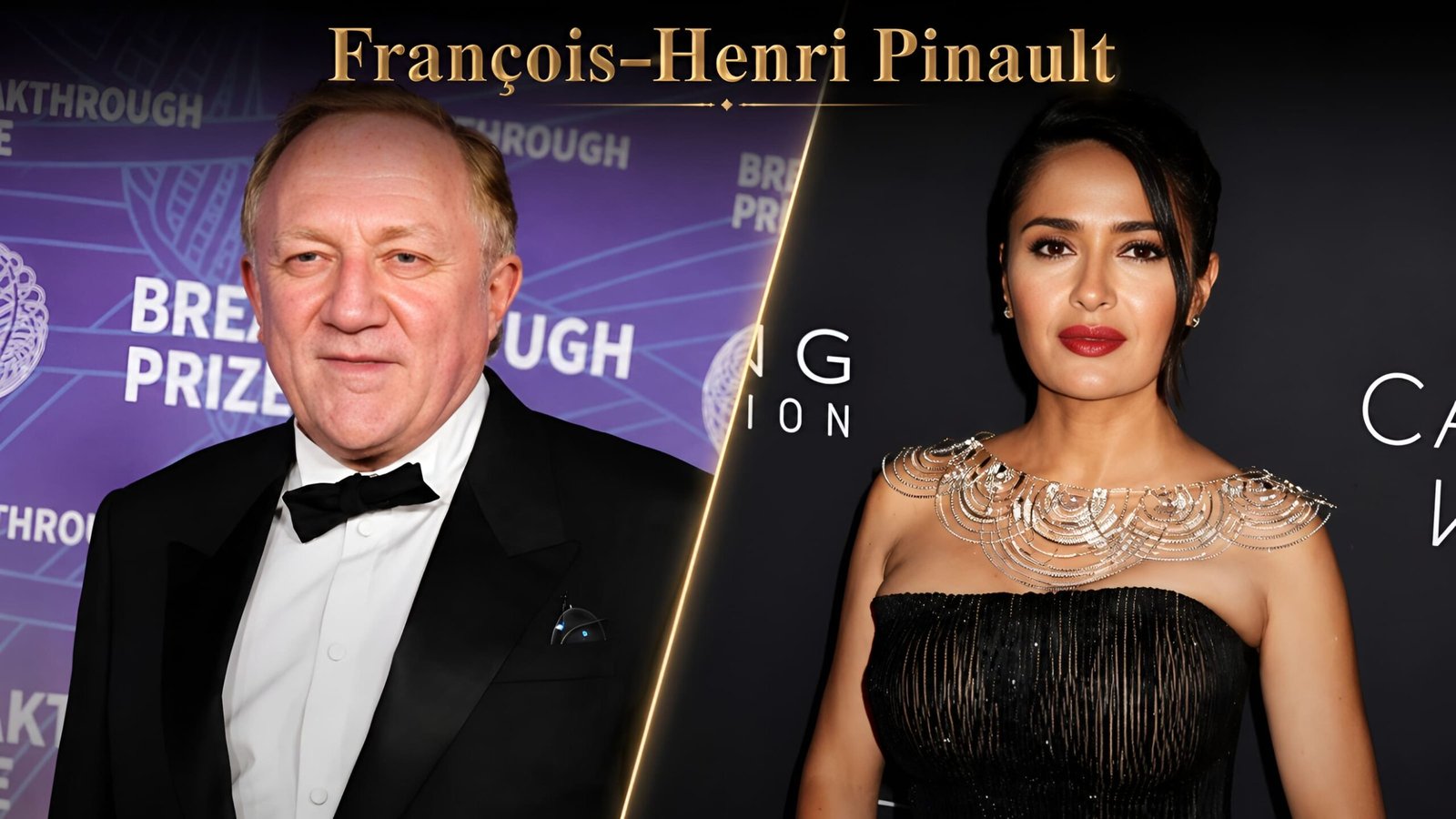
François-Henri Pinault is a French billionaire businessman born in May 1962 in Rennes, France. He is the Chairman and CEO of Kering — the global luxury group owning Gucci, Balenciaga, Saint Laurent, and Bottega Veneta. He transformed his father’s retail conglomerate into a world-leading luxury powerhouse and has been married to Hollywood actress Salma Hayek since 2009.
Quick Bio Table
| Detail | Information |
| Full Name | François-Henri Pinault |
| Born | May 28, 1962 |
| Birthplace | Rennes, France |
| Nationality | French |
| Education | HEC Paris (1985) |
| Profession | Businessman, Chairman & CEO |
| Company | Kering Group |
| Net Worth | ~$20.6 Billion (Forbes) |
| Spouse | Salma Hayek (married 2009) |
| Children | Valentina Paloma Pinault (with Salma Hayek) + 3 from previous relationships |
| Father | François Pinault (founder of Kering) |
| Key Brands | Gucci, Balenciaga, Saint Laurent, Bottega Veneta, Alexander McQueen |
Who is François-Henri Pinault?
François-Henri Pinault is one of the most powerful figures in the global luxury industry. Born in May 1962 in Rennes, in the northwest of France, he grew up in the shadow of his father’s enormous business empire. He was the second of three children and was raised in an entrepreneurial household that would shape his entire worldview. From childhood, business was not just a career choice — it was a family legacy carved into his identity.
His father, François Pinault, started a timber-trading business in 1963 — just one year after François-Henri was born. That humble beginning eventually transformed into one of the most powerful luxury conglomerates on the planet. François-Henri inherited not just a company but a vision: to build something enduring, transformative, and globally influential. This sense of purpose has defined every decision he has made as a business leader.
François-Henri Pinault’s Early Life and Education That Shaped a Billionaire
Growing up in Rennes, François-Henri Pinault was exposed early to the workings of commerce, strategy, and ambition. His upbringing was privileged yet grounded, shaped by a father who understood hard work and calculated risk-taking. These formative years gave him a rare combination of inherited insight and personal discipline that would later distinguish his leadership style from other executives of his generation.
He pursued his higher education at HEC Paris — one of France’s most elite business schools — graduating in 1985. HEC Paris is renowned for producing world-class business leaders, and Pinault used his time there to develop deep skills in financial management, corporate strategy, and international business. His academic foundation, combined with his family background, positioned him perfectly to eventually lead one of the world’s most complex luxury empires.
How François-Henri Pinault Joined the Family Business and Built His Own Legacy
After completing his education in 1985, Pinault joined the family business in 1987 and began working across various divisions of what was then called PPR (Pinault-Printemps-Redoute). He did not walk in as a privileged heir expecting easy authority — instead, he spent years managing subsidiaries, overseeing international operations, and gaining hands-on experience in retail management. This ground-level exposure gave him deep operational knowledge rarely found among executives who rise through finance alone.
In 2001, his father elevated him to co-CEO of Financière Pinault, the family holding company. This was a clear signal that François-Henri was being groomed for the very top. His rise through the ranks was methodical, deliberate, and impressive. By 2005, at the age of 43, he officially took over as Chairman and CEO of PPR, inheriting a retail conglomerate that still had major interests in timber, mass-market retail, and fashion brands. What he did next would define his legacy entirely.
François-Henri Pinault’s First Marriage and Family with Dorothée Lepère
Before his marriage to Hollywood actress Salma Hayek, François-Henri Pinault was previously married to French interior designer Dorothée Lepère. Their relationship took place during the early phase of his business career, before he became one of the most influential figures in the global luxury industry.
The couple was married in the late 1990s and later separated in 2004. From this marriage, François-Henri Pinault has two children: François Pinault Jr. and Mathilde Pinault. Both children have remained connected to the Pinault family legacy, with Mathilde Pinault especially gaining public attention in equestrian sports and social events linked to the luxury and fashion world.
This earlier chapter of his life is often highlighted as part of his personal journey before stepping fully into global leadership at Kering. It shows that alongside building his business empire, Pinault’s family life has evolved through different stages, eventually leading to his later relationship with Salma Hayek.
The Transformation of PPR into Kering: A Strategic Masterstroke in Luxury
When François-Henri Pinault took the helm of PPR in 2005, luxury brands represented only about 10% of the group’s total business. Within a decade and a half, he would reverse that ratio completely, turning Kering into a pure luxury powerhouse known worldwide. He made the bold strategic decision to divest all mass-market and retail assets — including Fnac, Conforama, Printemps, and La Redoute — and concentrate fully on luxury fashion and lifestyle brands. This was a transformative gamble that paid off spectacularly.
Under his leadership, Kering acquired and strengthened iconic brands like Yves Saint Laurent, Sergio Rossi, Boucheron, Bottega Veneta, and Balenciaga. The group also expanded Gucci’s global reach dramatically, turning it into one of the most recognizable luxury labels on earth. In 2013, the rebranding from PPR to Kering — derived from the Breton word “ker” meaning “home” — symbolized the group’s new identity as a modern luxury group with a clear sense of purpose and belonging.
Kering’s Global Brand Portfolio: The Luxury Empire Under Pinault’s Vision
Kering under François-Henri Pinault’s leadership became a global luxury empire with a portfolio that fashion lovers and business analysts alike admire deeply. The group’s flagship brand Gucci generates billions in annual revenue and remains one of the most coveted fashion labels in the world. Saint Laurent, Balenciaga, Bottega Veneta, and Alexander McQueen round out a luxury collection that spans ready-to-wear, leather goods, footwear, and fine jewelry.
Beyond fashion, Kering also held interests in the jewelry segment through Boucheron, Pomellato, and Qeelin — reinforcing its strategy of owning deeply aspirational brands across multiple luxury categories. The group reported revenues of €13.6 billion in 2018, a figure that reflected years of precise brand cultivation and strategic positioning. Each brand under Kering’s umbrella maintained its own creative identity while benefiting from the financial strength and infrastructure of the larger group.
Pinault’s Commitment to Sustainability: Redefining Responsible Luxury
One of the defining features of François-Henri Pinault’s leadership has been his genuine and pioneering commitment to sustainability in the luxury sector. In 2011, he implemented wide-ranging ecological and social initiatives within Kering, including the development of environmental profit-and-loss statements — a financial model that measures environmental impact in monetary terms. This was a radical and forward-thinking approach that set Kering apart from almost every other luxury group of its size.
Kering under Pinault became an industry leader in corporate social responsibility, launching sustainable sourcing programs, investing in responsible material innovation, and publishing detailed sustainability reports. He also chairs Kering’s Corporate Foundation for Women’s Dignity and Rights, which works globally to combat gender-based violence and support women’s empowerment. This dual commitment — to beautiful luxury products and to responsible business — represents Pinault’s most enduring contribution to how modern luxury companies should operate.
Groupe Artémis: The Pinault Family’s Broader Cultural and Investment Empire
Beyond Kering, François-Henri Pinault also presides over Groupe Artémis — the family holding company that controls a remarkable range of cultural, artistic, and investment assets. Artémis owns Christie’s, the world-famous auction house, giving the Pinault family enormous influence over the global art market. It also owns Château Latour, the prestigious Bordeaux winery, and Creative Artists Agency (CAA), one of Hollywood’s most powerful talent representation firms.
The family’s art collection, assembled over decades, includes over 3,000 works by masters like Picasso, Mondrian, and Jeff Koons. In 2021, the Pinault family opened the Bourse de Commerce in Paris — a stunning contemporary art museum that houses a significant portion of this collection and has quickly become one of Paris’s most talked-about cultural destinations. This breadth of cultural engagement shows that François-Henri Pinault is not simply a businessman but a genuine patron of global culture and the arts.
François-Henri Pinault’s Net Worth and Place Among the World’s Ultra-Wealthy
Forbes has ranked François-Henri Pinault among the world’s wealthiest individuals, with an estimated personal net worth of approximately $20.6 billion. The broader Pinault family, including the wealth managed through Groupe Artémis and the elder François Pinault’s assets, is collectively worth over $40 billion. This places the Pinaults among the most significant business dynasties in France and in the global luxury sector, second only to the Arnault family of LVMH in terms of luxury industry influence.
His wealth is not simply inherited — it is amplified and multiplied through two decades of disciplined strategic management. By refocusing Kering exclusively on luxury, acquiring undervalued brands and developing them into global powerhouses, and pioneering sustainability as a core business value, Pinault has created enormous shareholder value and personal wealth simultaneously. His business story is a masterclass in how inherited advantage can be transformed through vision, patience, and strategic boldness into something far greater.
Stepping Back from Kering Operations at Age 63: A Leadership Transition
In 2025, at the age of 63, François-Henri Pinault announced that he would step back from the day-to-day operational management of Kering, though he would remain as Board Chairman. This decision mirrored a pattern set by his own father, François Pinault, who also stepped back from active management at age 66. Interestingly, this contrasts sharply with LVMH’s Bernard Arnault, who renewed his mandate at the head of his group until the age of 85, reflecting very different philosophies about succession and legacy management.
Pinault’s decision to step back at 63 is widely seen as a deliberate and thoughtful choice to begin a generational transition for the family empire. Having spent twenty years transforming Kering from a retail conglomerate into the world’s second-largest luxury group, he chose to exit operational management while the company was still strong, rather than clinging to power. This kind of graceful transition speaks to a leader more interested in the long-term health of his family’s legacy than in personal title and authority.
François-Henri Pinault and His Impact on the Global Fashion Industry
The fashion industry has been profoundly shaped by François-Henri Pinault’s leadership decisions over two decades. His approach of allowing creative directors significant autonomy within a financially disciplined framework helped revive brands like Gucci and Saint Laurent during periods when they had lost their cultural relevance. His willingness to invest in bold, avant-garde creative talent — rather than chasing short-term commercial trends — gave Kering brands a reputation for genuine creative leadership.
The broader fashion industry has also taken note of Kering’s sustainability commitments and has been pushed — often reluctantly — to adopt more responsible practices as a result of Pinault’s public advocacy. His environmental profit-and-loss methodology has been adopted or studied by companies across the sector, and his foundation’s work on women’s rights has helped elevate the conversation about gender equity within the fashion world. His legacy as a business leader is inseparable from his legacy as a reformer of how luxury fashion thinks about its responsibilities.
Who is Salma Hayek? The Hollywood Star Whose Life Intertwined with Pinault’s
Salma Hayek Pinault is a Mexican-American actress, producer, and philanthropist who was born on September 2, 1966, in Coatzacoalcos, Veracruz, Mexico. Her father, Sami Hayek, was a wealthy oil executive of Lebanese-Mexican heritage, and her mother, Diana Jiménez Medina, was an opera singer and talent scout. She grew up in a culturally rich and financially comfortable household that exposed her to the arts from a very young age, planting the seeds of her future career in entertainment.
Salma Hayek began her acting career in Mexican telenovelas in the late 1980s, most notably the popular series “Teresa.” Her ambition pushed her beyond Mexico’s borders to Hollywood, where she faced enormous barriers as a Latina actress in an industry that often pigeonholed performers of her background. Despite these obstacles, she persevered and landed her English-language breakthrough in Robert Rodriguez’s 1995 action film “Desperado,” alongside Antonio Banderas, which launched her onto the international stage.
Salma Hayek’s Oscar-Nominated Breakthrough and Her Role as Producer and Activist
Salma Hayek’s most celebrated achievement in Hollywood came with the 2002 biographical film “Frida,” in which she portrayed legendary Mexican artist Frida Kahlo. Hayek not only starred in the film but also produced it through her production company Ventanarosa, fighting for years to get the project made against significant industry resistance. The film was a critical and commercial triumph, and Hayek became the first Mexican woman ever nominated for the Academy Award for Best Actress — a historic milestone for Latina representation in Hollywood.
Beyond “Frida,” Hayek expanded her producing career significantly with the hit television series “Ugly Betty,” which she executive produced and which earned multiple Emmy nominations. She has since appeared in major Hollywood productions including “Eternals” (2021) as part of the Marvel Cinematic Universe and “House of Gucci” (2021). As of 2025, her net worth is estimated at approximately $200 million, reflecting decades of acting income, production revenues, and business ventures including her beauty line Nuance by Salma Hayek.
The Love Story of François-Henri Pinault and Salma Hayek: Power Meets Passion
The relationship between François-Henri Pinault and Salma Hayek began in 2006 when they met at a gala at the Palazzo Grassi in Venice — one of the family’s key art venues. Their connection was immediate and genuine, bridging two very different worlds: French luxury business empire and Hollywood stardom. The following year, in 2007, they welcomed their daughter, Valentina Paloma Pinault, into the world. Their family story became one of the most talked-about power couple narratives in both entertainment and business media.
The couple married on Valentine’s Day, February 14, 2009, in Paris — a ceremony as romantic as it was symbolically apt for one of the world’s most glamorous couples. Their union connects two enormous spheres of cultural and economic influence: Pinault’s luxury fashion empire and Hayek’s Hollywood production legacy. They own multiple homes around the world, including properties in Paris, London, and Los Angeles. Their marriage represents not just a romantic partnership but a merging of two remarkable personal brands built on talent, ambition, and authenticity.
The Pinault-Hayek Partnership: How Two Different Worlds Strengthen Each Other
The union between François-Henri Pinault and Salma Hayek has proven to be more than a romantic partnership — it is a genuine meeting of complementary strengths. Pinault’s acquisition of Creative Artists Agency (CAA) through Groupe Artémis reflects an understanding that celebrity culture and luxury brands are deeply intertwined markets. Hayek’s deep roots in Hollywood, her understanding of storytelling, and her global brand recognition are natural assets within this expanded media and talent ecosystem that Pinault is building.
On the personal level, both individuals share a commitment to philanthropy, gender equality advocacy, and cultural patronage that binds their public identities together. Hayek’s UNICEF campaign to combat tetanus has raised over $7 million, while Pinault chairs the Kering Foundation dedicated to women’s dignity. Their shared values around social responsibility and cultural investment make their partnership feel genuinely coherent rather than purely transactional or celebrity-driven.
François-Henri Pinault’s Philanthropic Legacy and Cultural Contributions
Philanthropy and cultural investment have always been central to how François-Henri Pinault presents himself to the world. The Pinault Collection, housed at the magnificent Bourse de Commerce in Paris, is one of Europe’s most significant private art collections open to the public. Investing in Tadao Ando’s architectural restoration of the historic circular building and filling it with world-class contemporary art is an act of genuine cultural generosity that has enriched Paris’s artistic landscape enormously.
Through Kering’s corporate foundation, Pinault has committed substantial resources to fighting violence against women globally, running programs in partnership with grassroots organizations across Africa, Asia, and Europe. His environmental initiatives, particularly Kering’s environmental profit-and-loss account system, have contributed real intellectual capital to the debate about how luxury companies should measure and manage their ecological footprint. These are not superficial gestures — they represent a sustained, serious commitment to using business influence for broader good.
Conclusion: A Legacy Built on Vision, Love, and Responsibility
François-Henri Pinault stands as one of the defining business figures of the early 21st century — a man who inherited an empire and made it incomparably greater through vision, courage, and a genuine commitment to making luxury mean something beyond material excess. His transformation of Kering, his sustainability leadership, his cultural investments, and his graceful leadership transition all speak to a person who thinks in decades, not quarters.
His partnership with Salma Hayek adds a deeply human and culturally rich dimension to this story. Together, they represent a fusion of European luxury heritage and Latin American Hollywood spirit — two worlds that, under their influence, have grown closer and more intertwined than ever before. Their shared commitment to philanthropy, culture, and family makes their story not just a business case study or celebrity narrative, but a genuinely inspiring human journey. The Pinault-Hayek legacy is still being written — and it promises to be extraordinary.
Frequently Asked Questions (FAQs)
Q1. Who is François-Henri Pinault?
François-Henri Pinault is a French billionaire businessman, Chairman and CEO of Kering — the global luxury group that owns Gucci, Balenciaga, Saint Laurent, and Bottega Veneta.
Q2. What is François-Henri Pinault’s net worth?
His personal net worth is estimated at approximately $20.6 billion according to Forbes, with the broader Pinault family worth over $40 billion.
Q3. Who is François-Henri Pinault married to?
He is married to Mexican-American actress and producer Salma Hayek. They married on Valentine’s Day, February 14, 2009, in Paris.
Q4. What brands does Kering own?
Kering owns Gucci, Balenciaga, Yves Saint Laurent, Bottega Veneta, Alexander McQueen, Boucheron, Pomellato, and several other luxury brands.
Q5. When did François-Henri Pinault take over Kering?
He became Chairman and CEO of the group (then called PPR) in 2005, succeeding his father François Pinault.
Q6. Who is Salma Hayek?
Salma Hayek is a Mexican-American actress, producer, and philanthropist, famous for her roles in “Frida” (2002) and “Desperado” (1995). She earned an Oscar nomination for Best Actress for “Frida” and has a net worth of approximately $200 million.
Q7. Do François-Henri Pinault and Salma Hayek have children together?
Yes. They have one daughter together, Valentina Paloma Pinault, born in 2007. Pinault also has three children from previous relationships.
Fore more info: Usasparktime.co.uk
