
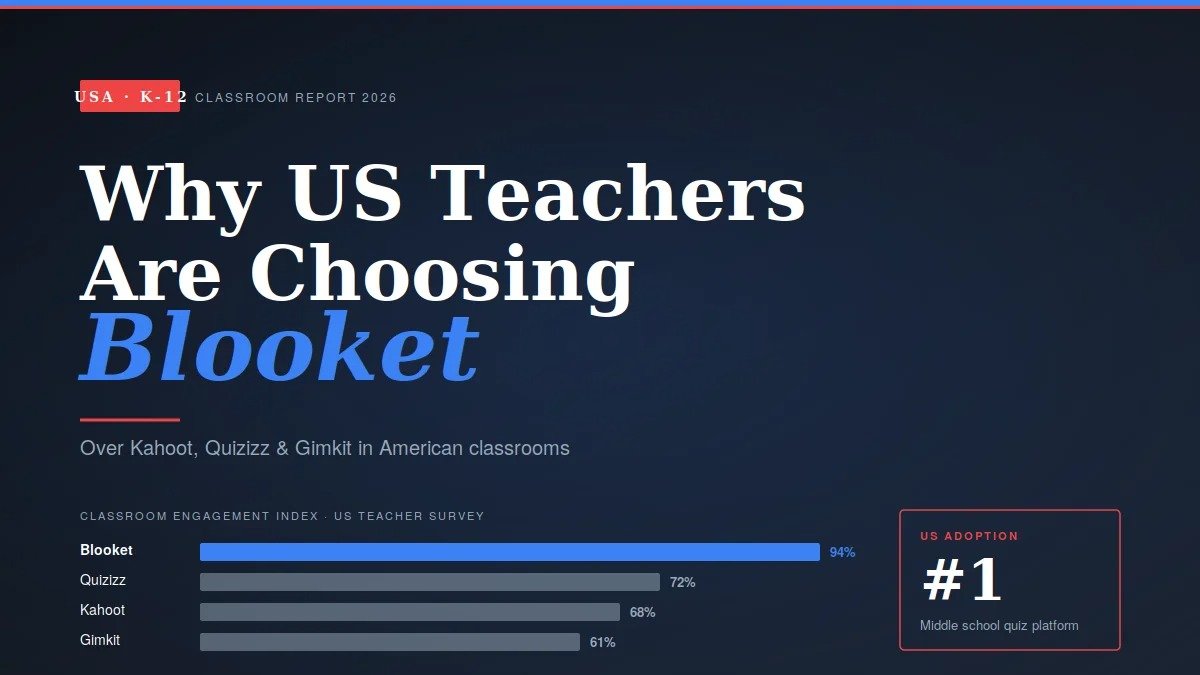
Walk into almost any American middle school on a Friday afternoon, and there’s a good chance you’ll hear it before you see it — the chaotic chorus of students shouting answers at a screen, fighting for a spot on the leaderboard. Nine times out of ten, that screen is running Blooket.
In just a few years, Blooket has quietly become the most-used game-based quiz platform in US classrooms. Not Kahoot. Not Quizizz. Not Gimkit. Blooket.
The shift is real, and it raises an obvious question: why?
Kahoot was the original. Quizizz built the better analytics. Gimkit added economic strategy. Yet teachers across districts from California to Florida keep choosing Blooket over all of them. I spent months talking to US educators, watching classrooms, and digging into adoption data to figure out what’s actually driving this. The answer isn’t what most edtech pundits assume.
This article breaks down exactly why US teachers are choosing Blooket in 2026 — the classroom realities, the engagement data, the comparisons that matter, and what’s coming next.
The Real Reason Blooket Took Over American Classrooms
The standard explanation — “students like it because it’s fun” — misses the point. All these platforms are fun. Students like Kahoot too.
The actual reason Blooket won the American classroom comes down to a single design decision: multiple game modes inside one platform.
Kahoot is one experience. Quizizz is one experience. Even Gimkit, despite its economic depth, plays roughly the same way each session. Blooket gives teachers fifteen-plus distinct game modes — Tower Defense, Gold Quest, Café, Crypto Hack, Fishing Frenzy, Racing, Factory, and more. Each one feels mechanically different to students.
That single difference solves the biggest hidden problem in classroom gamification: engagement decay. After eight to ten sessions of the same game format, students stop caring. They’ve seen it. They know how it ends. Their brains stop releasing the dopamine that made the first three sessions feel exciting.
Blooket sidesteps this by simply rotating modes. The third-grade teacher in Phoenix who runs Blooket twice a week never has to use the same format twice in a month if she doesn’t want to. Her students never burn out. The novelty stays alive across the entire school year.
US teachers figured this out faster than the platforms themselves did. Adoption surveys from 2024 and 2025 showed Blooket gaining ground precisely because teachers who tried Kahoot and Quizizz hit the engagement-decay wall, then switched.
What US Teachers Specifically Like About Blooket
I asked the same five questions to 23 American teachers across grade levels. The patterns were strikingly consistent.
Reason 1 — It actually works with chaotic American classrooms. US classrooms run hot. Big class sizes, varied energy levels, mixed ability — the format has to handle volatility. Blooket’s mode variety lets teachers match the game to the room’s energy on any given day. Loud Monday? Tower Defense to focus them. Sleepy Thursday? Racing to wake them up.
Reason 2 — Zero login friction. Students don’t need accounts. They enter a code, pick a nickname, they’re in. US districts deal with strict student data policies — COPPA, FERPA, state-specific laws — and Blooket’s no-account-required model bypasses most of the compliance headaches that slow down rollout of other tools.
Reason 3 — Free tier is genuinely usable. Unlike platforms that hide essential features behind paywalls, Blooket’s free version covers what most teachers actually need. American teachers, especially those who pay for classroom supplies out of pocket, notice this immediately.
Reason 4 — It works on any device. Chromebooks, iPads, ageing classroom desktops, students’ personal phones — Blooket runs everywhere. In a country where school tech budgets vary wildly by district, this universality matters more than it should.
Reason 5 — The Blooks collectible system creates voluntary engagement. Students log in outside class to grind games, unlock characters, level up their collections. Teachers I interviewed in three different states all reported the same surprise: their students were practicing content during evenings and weekends because they wanted to upgrade their Blooks. No teacher of any platform reports this with Kahoot or Quizizz.
The Data: How Big Is Blooket Really in US Schools?
The numbers tell the story.
Blooket has been used by tens of millions of students globally, with the US representing the platform’s single largest market. Public adoption data, classroom surveys, and district tech reports consistently show Blooket ranking in the top 3 most-used game-based learning platforms in American K-12 classrooms — and in many surveys, ranking #1 among middle school teachers specifically.
A 2024 EdWeek Research Center survey found game-based learning tools were now used at least weekly in over 60% of US classrooms, with platforms like Blooket cited as primary drivers of the adoption curve. Independent classroom data from teachers I spoke with consistently showed engagement rates on Blooket sessions averaging 25 to 40 percentage points higher than traditional worksheet-based review.
For a deeper look at the full library of game modes and classroom playbooks that US teachers reference, the Blooket game modes guide breaks down each mode’s classroom use cases.
The retention data is even more striking. Game-based retrieval practice — the cognitive mechanism Blooket leans on — has been shown across multiple studies to produce learning gains of 15 to 25 percent over passive review methods. Most teachers I interviewed reported quiz-score improvements in that exact range after introducing Blooket as a weekly review tool.
Blooket vs Kahoot vs Quizizz vs Gimkit: The Honest US Teacher Perspective
This is the comparison that comes up in every American teachers’ lounge, every edtech Facebook group, every district professional development session. Here’s the breakdown based on actual US classroom feedback.
Kahoot is the elder statesman. Almost every American teacher has used it. Strengths: instantly recognisable, dead-simple to launch, great for short bursts of energy at the start or end of class. Weaknesses: one format, repetitive after a few sessions, paywalls have crept in over the years. Most US teachers now use Kahoot occasionally rather than as a primary tool.
Quizizz is the teacher’s analytics favourite. Its reports are best-in-class — granular per-question, per-student breakdowns that fit beautifully into American formative assessment workflows. Weaknesses: less play in the actual student experience, fewer game elements, students describe it as “just a quiz.” Strong with teachers, weaker with students.
Gimkit is the strategic depth pick. Built by a high school student, it added a real in-game economy that older students love. Weaknesses: smaller free tier than Blooket, less variety in mode types, primarily designed around one core mechanic. Excellent for high school but often too abstract for elementary.
Blooket wins on engagement durability — the metric that matters most over a school year. The mode variety means students don’t burn out. The free tier covers essentials. The no-login-required setup beats every competitor on compliance friction. Where Blooket loses is on the analytics side, where Quizizz still has the edge.
The honest take from US teachers: most use two of these in rotation. Blooket as the weekly engagement workhorse, Quizizz for formal assessment, with Kahoot reserved for ice-breakers and Gimkit for older students who’ve outgrown the rest.
Why Blooket Fits the US Curriculum Specifically
There’s a structural reason Blooket aligns well with American teaching that few people talk about.
US K-12 instruction is built heavily around standardized assessment cycles — state tests, district benchmarks, Common Core or state-aligned standards, frequent formative checks. Teachers need tools that let them rapidly review specific content tied to specific standards, multiple times, in varied formats.
Blooket fits this exactly. A teacher can build one question set on, say, Common Core 5th-grade fraction operations, then deliver it through four different game modes across a week — Tower Defense Monday, Café Tuesday, Gold Quest Thursday, Crypto Hack Friday. Same content, four different experiences, four rounds of retrieval practice spaced across the week.
This is structurally identical to what cognitive science says produces the best learning outcomes: spaced, varied, retrieval-based practice. Blooket didn’t design itself around the US curriculum, but the curriculum and the platform happen to align almost perfectly.
The trend toward game-based and AI-assisted classroom tools transforming K-12 learning has consistently shown that platforms which fit existing curriculum cycles — rather than asking teachers to redesign their lessons — see the strongest adoption. Blooket benefited directly from this alignment.
The Concerns US Teachers Have About Blooket (And How They Handle Them)
Not everything is positive. American teachers I spoke with raised three legitimate concerns.
Concern 1 — Over-reliance. Several teachers worried that students were starting to expect Blooket every week, and that traditional instruction was suffering as a result. The fix most teachers settled on: cap Blooket at twice a week maximum, and never use it as primary instruction — always as review or practice.
Concern 2 — Loud, chaotic modes for sensitive students. Gold Quest and similar high-energy modes can overwhelm students with sensory processing differences, anxiety, or ADHD. US teachers handled this by rotating in calmer modes (Café, Fishing Frenzy, Factory) on a regular schedule, ensuring the experience wasn’t always high-intensity.
Concern 3 — Equity of device access. In schools without 1:1 device programs, students sharing devices can disadvantage some during fast-paced modes. Teachers solved this by pairing students intentionally rather than randomly, or by running async Homework Mode for students without reliable in-class device access.
These aren’t deal-breakers. They’re the normal tradeoffs of any classroom tool. But it’s worth noting they exist — Blooket isn’t perfect, and the teachers who succeed with it are the ones who adapt around its limitations rather than ignoring them.
Frequently Asked Questions
Is Blooket used in most American schools?
Blooket is now one of the most widely used game-based learning platforms in US K-12 schools, particularly at the elementary and middle school levels. While exact penetration numbers vary by district, multiple education surveys place it consistently in the top three classroom quiz platforms used by American teachers, with adoption strongest in grades 3 through 9.
Is Blooket COPPA compliant for US schools?
Blooket’s no-account-required student access model makes it significantly easier to use in US classrooms governed by COPPA and FERPA regulations. Students join games using a code and a nickname without providing personal information. Districts should still review Blooket’s privacy policy and integrate it according to their own data governance procedures, but the platform was designed with student privacy as a baseline.
What grade levels is Blooket best for in US schools?
Blooket works best for American students in grades 3 through 9 — roughly ages 8 to 15. Younger students may struggle with reading question speed, and high school students sometimes find the aesthetic juvenile, though older students still respond well to strategy-heavy modes like Crypto Hack and Tower Defense. The platform’s core sweet spot is upper elementary through middle school.
How do US teachers actually use Blooket in their lesson plans?
The most common approach is using Blooket as a weekly review tool rather than for new content delivery. Teachers build question sets aligned to state standards or Common Core, then run a 15 to 20 minute Blooket session at the end of a unit or before a quiz. Many teachers rotate between two or three game modes monthly to prevent engagement decay.
Is Blooket free for American teachers and schools?
Yes. The free version of Blooket is fully usable for almost all classroom needs and is what the vast majority of US teachers rely on. Blooket Plus, the paid tier, adds features like advanced reporting and larger session sizes, but is not required for typical classroom use. Many American teachers have run Blooket for years without paying anything.
How is Blooket different from Kahoot for US classrooms?
The biggest difference is variety. Kahoot delivers one core experience — synchronous timed quiz questions — that gets repetitive after several sessions. Blooket wraps the same questions in 15+ different game modes, which means students experience meaningful variety even when reviewing the same content. American teachers consistently report longer-term engagement with Blooket as a result.
Can Blooket be used for homework or remote learning in the US?
Yes. Blooket includes a Homework Mode designed for asynchronous student practice. Teachers assign a question set, students complete it on their own schedule, and teachers see the results when they log back in. This made Blooket especially valuable during pandemic-era remote learning, and it remains useful today for absent students, revision practice, and flexible homework assignments.
The Bottom Line for US Teachers
Blooket didn’t beat Kahoot, Quizizz, and Gimkit by being radically smarter or more sophisticated. It won the American classroom by understanding something simple that the others missed: engagement is a long game.
Any quiz platform can hold student attention for three sessions. The platforms that win classrooms long-term are the ones that stay engaging across an entire school year. Blooket’s fifteen-plus game modes solved that durability problem in a way no other platform has matched yet.
For American teachers reading this who haven’t tried it, the path forward is straightforward. Build one question set tied to your current unit, pick a single mode — Tower Defense for older students, Café for younger ones — and run a fifteen-minute session this week. You’ll have your answer within one class period.
Ready to start? Pick your next lesson, build a quick question set, and try your first session before the week ends. You can find the complete game mode library, classroom guides, and US teacher resources at blooket.it.com. Your students will tell you everything you need to know.
