
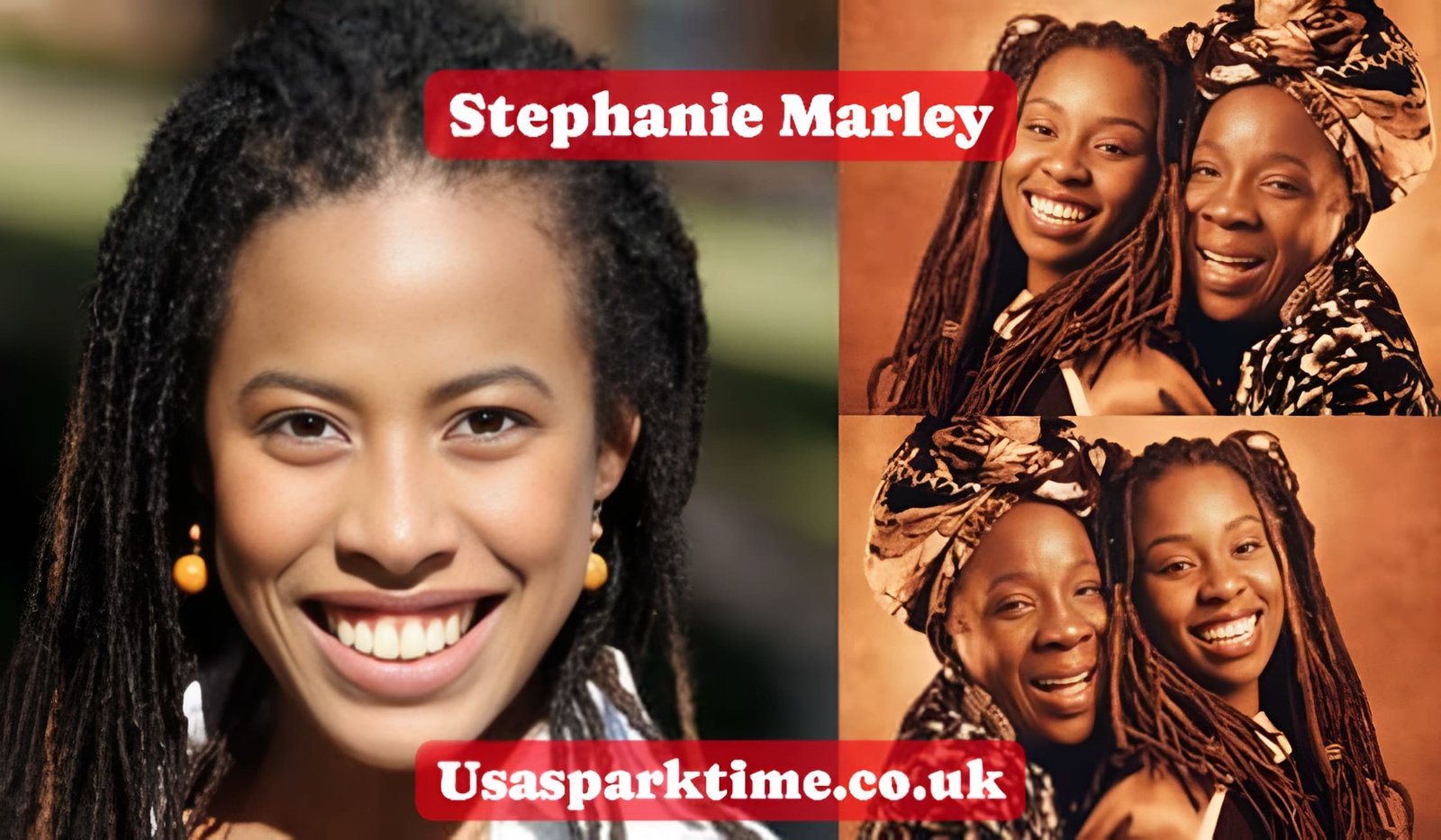
Stephanie Marley is the adopted daughter of reggae legend Bob Marley and Rita Marley, born on August 17, 1974, in Jamaica. Unlike her siblings, she pursued education and psychology, earning a BA from Western University in 1999. She is a counselling psychologist, humanitarian, founder of Wake Up Jamaica, and mother of four sons, including Universal Music artist King Cruff.
Stephanie Marley is not your typical Marley. Born in Jamaica in 1974 to Rita Marley and adopted by the legendary Bob Marley, she grew up surrounded by music yet chose a completely different path. Rather than following her Grammy-winning siblings into the recording studio, she pursued psychology in London and Canada. After graduating from Western University in 1999, she led major Marley family enterprises before becoming a counselling psychologist in Kingston. Today she is best known as the founder of Wake Up Jamaica, a movement for constitutional reform and national healing. A mother of four, her eldest son King Cruff is a rising music star. Her story is one of quiet courage, intellectual independence, and real-world impact — a different but equally powerful expression of the Marley legacy.
| Full Name | Stephanie Marley |
| Date of Birth | August 17, 1974 |
| Birthplace | Kingston, Jamaica |
| Biological Father | Owen “Ital Tacky” Stewart (Jamaican footballer) |
| Mother | Rita Marley (Queen of Reggae) |
| Adopted Father | Bob Marley (Reggae Legend) |
| Education | BA Psychology, Western University (1999); Graduate studies in counselling psychology, Jamaica |
| Profession | Counselling Psychologist, Humanitarian, Activist |
| Organization | Founder, Wake Up Jamaica |
| Children | 4 sons, including King Cruff (Solomon Marley-Spence) |
| Residence | Kingston, Jamaica |
| Net Worth (est. 2026) | ~$20 million |
| Siblings | Ziggy, Stephen, Cedella, Sharon Marley (and others) |
Introducing — Who Is Stephanie Marley?
Stephanie Marley is the adopted daughter of the world’s most iconic reggae musician, Bob Marley, and the biological daughter of Rita Marley and Owen “Ital Tacky” Stewart, a former Jamaican footballer. Born on August 17, 1974, in Kingston, Jamaica, she grew up in one of the most famous households in music history. Yet while her brothers and sisters went on to become Grammy-winning artists and entertainers, Stephanie chose an entirely different road — one paved with academic achievement, psychological practice, and social activism. Her story quietly challenges the world’s expectations of what it means to carry the Marley name.
A Childhood Shaped by Legend and Love
Growing up in the Marley household meant living inside a musical universe. From watching her parents record tracks in the studio to witnessing the power of music firsthand, Stephanie absorbed the family’s deep spiritual and cultural values rooted in Rastafarianism. Bob Marley, whom she remembers as “soft and gentle,” adopted her legally and raised her as his own, entitling her to his estate. Her early years taught her that the Marley name was not just about fame — it was about purpose, unity, and lifting others.
Despite the global spotlight surrounding her family, Stephanie enjoyed a grounded childhood in Jamaica where she and her siblings were treated as ordinary students. In fact, several of her teachers were deliberately harder on the Marley children to ensure they felt no more privileged than anyone else. This humbling environment helped shape a woman who would later dedicate her life to public service. She recalls appreciating that experience deeply, wanting the same grounded upbringing for her own four sons, all of whom she chose to raise in Kingston rather than abroad.
The defining trauma of her early life came in December 1976, when an assassination attempt targeted Bob Marley at his Kingston home. Two-year-old Stephanie was among the family members forced into sudden exile, first to the Bahamas. Though she was too young to remember the details clearly, the event shaped the family’s extraordinary closeness and fierce protectiveness of one another. That bond of unity, forged under threat and exile, became a lifelong pillar of Stephanie’s identity and would later echo in her national healing work through Wake Up Jamaica.
Education: The Path She Chose Against the Grain
Breaking the Marley Mold with Academic Ambition
While her siblings were cutting records and touring stages, Stephanie Marley was hitting the books. She completed her A-Levels in social studies and psychology in London, United Kingdom, demonstrating early on that her intellectual curiosity ran deep. She was never drawn to performance the way her brothers and sisters were. Instead, she was fascinated by the science of human behavior — how people think, heal, struggle, and grow. This passion for understanding people on a psychological level would guide every major decision she made in the years to come.
Her academic journey took her to Western University in Ontario, Canada, where she earned her Bachelor of Arts degree in Psychology in 1999. She is widely recognized as one of the first members of the Marley family to achieve a university degree, a milestone that speaks volumes about her priorities and drive. Her time in London, Ontario, holds a special place in her heart — she has called it her “second home” and it was there that she gave birth to her son Solomon, better known to the world now as the rising music artist King Cruff. The city offered her both education and early motherhood in the same chapter.
After years away from formal study, Stephanie returned to Western University in 2016 with plans to pursue a master’s degree in psychology. However, when her mother Rita Marley suffered a stroke that year, she made the selfless decision to return to Jamaica to provide care. She did not abandon her academic goals — she completed her graduate studies in counselling psychology in Jamaica, where she now runs her own private psychology practice in Kingston and maintains ties with the University of Technology in Jamaica. Her education story is one of persistence over comfort.
Career and Business Leadership in the Marley Empire
Managing the Heart of the Marley Legacy
After graduating from Western University, Stephanie did not retreat into private life. Between 2000 and 2003, she served as managing director of several key Marley family institutions, including Tuff Gong International, the Bob Marley Museum, and the Rita Marley Foundation. These were not ceremonial roles. She was operating at the center of one of the most influential cultural brands in the world, managing music catalogues, museum programming, and charitable initiatives simultaneously. Her business instincts, combined with her deep personal connection to the legacy, made her uniquely qualified for this responsibility.
From 2003 to 2010, Stephanie shifted her focus to developing the Marley Resort and Spa in Nassau, Bahamas — a luxury hospitality project that carried the family’s spiritual and aesthetic identity into the world of travel and wellness. Working alongside her sister Cedella Marley on the design and atmosphere of the resort, she blended business strategy with creative vision. The project was a testament to her versatility: she was not just a brand manager but a creative collaborator capable of translating the Marley philosophy into physical spaces designed for rest and healing.
Alongside her corporate work, Stephanie also worked as a talent agent with B’unik Modeling Talent Agency, a role that reflected her comfort navigating the creative industries without seeking the limelight herself. In every professional chapter, she found ways to serve, build, and lead while maintaining the personal privacy that has always defined her public posture. It is this consistent pattern of quiet, effective contribution that has earned her growing admiration from those who follow the Marley story closely.
Also read this: Bry Burrows: The Brilliant IBM AI Expert Who Stole Jalen Hurts’ Heart
Stephanie Marley as a Counselling Psychologist
Healing People Through Professional Practice
Today, Stephanie Marley practices as a qualified counselling psychologist in Kingston, Jamaica, where she runs her own private clinic. Her approach to psychology is deeply informed by her lived experience — growing up in a family that understood the power of music to heal emotional wounds, surviving political exile, and watching her country wrestle with post-colonial trauma. She brings all of this personal depth to her work with clients, helping individuals navigate personal challenges, mental health struggles, and life transitions with empathy and professional expertise.
Her connection to the University of Technology in Jamaica gives her work an academic dimension as well, keeping her practice grounded in current research and evidence-based methods. She has spoken publicly about the psychological phenomenon of national numbness — the idea that collective pain causes societies to become emotionally comatose, unable to act or change. This insight, drawn from her clinical training, directly shapes the philosophy of Wake Up Jamaica, her most visible public project. For Stephanie, psychology is not just a profession — it is a lens through which she reads and seeks to heal an entire nation.
In interviews, she has described the relationship between music and mental health as one of the most powerful healing tools available to Jamaicans. “I know as a psychologist, and from coming from a musical family, the healing power of music and the impact it has,” she has said. This cross-disciplinary thinking — applying psychological science to cultural and national contexts — is what sets her apart as a thinker and practitioner. She is not content to simply treat individuals in isolation; she wants to address the systemic roots of suffering that affect communities across Jamaica.
Wake Up Jamaica: Leading a Movement for National Change
Why She Founded Wake Up Jamaica
Wake Up Jamaica is perhaps the most ambitious project of Stephanie Marley’s life. She founded the organization in response to growing concern that Jamaica’s government was moving toward constitutional reform — specifically, transitioning from a monarchy to a republic — without genuinely consulting or involving its citizens. Stephanie and other advocates recognized that ordinary Jamaicans were being excluded from a process that would fundamentally reshape their nation’s identity. She stepped in with the conviction that change must be created by the people, not handed down from above.
The campaign works through a combination of digital outreach, printed materials, and community “wake-up sessions” that break down complex constitutional concepts into accessible, practical language. The organization’s website and booklets offer “bite-sized” pieces of information designed to make civic education approachable for everyone. Stephanie draws on her psychology training to understand why people disengage from politics, and uses that knowledge to design campaigns that speak to citizens’ emotions, histories, and sense of identity. It is civic education reimagined through a therapeutic lens.
Her goal is not merely political but deeply psychological and cultural. She envisions a multi-step process that begins with individual self-awareness, moves through family and community engagement, and ultimately reaches national healing. “We’re hoping to bring true liberation and real emancipation, so people are no longer comatose,” she has said publicly. By bringing together musicians, activists, educators, and everyday citizens, Wake Up Jamaica reflects the same philosophy of unity that defined her father’s greatest songs — updated for a 21st-century democracy.
Family Legacy and Her Son King Cruff
Raising the Next Generation of Marleys
Stephanie Marley is the mother of four sons, all of whom she has chosen to raise in Kingston, Jamaica. Her decision to keep her children grounded in their homeland was deliberate and considered. Having observed some of her nephews and nieces grow up abroad under the weight of the Marley name, she wanted her own sons to develop identity and confidence free from that particular pressure. She enrolled them in Jamaican schools and raised them within the same cultural and spiritual values that shaped her own childhood.
Her eldest son Solomon Marley-Spence, who performs under the stage name King Cruff, has emerged as one of the most exciting voices in the new generation of Marley musicians. Signed to Universal Music Canada through Tuff Gong Collective, King Cruff blends hip-hop, reggae, and Afrobeats into a genre-defying sound that pays homage to his grandfather’s legacy while carving out something entirely his own. He has spoken warmly about the advice his mother gave him: “Words have power,” she told him — a line that directly inspired one of his breakout tracks. The mother-son artistic connection is deeply touching.
King Cruff was born in London, Ontario, during Stephanie’s university years, attended schools in Kingston, and later built his music career in Canada before achieving international recognition. His signing to Universal Music Canada marked a watershed moment for both the Tuff Gong Collective and the wider Marley family story. For Stephanie, watching her son thrive as a musician is a full-circle moment — she stepped away from the music world to pursue education and service, and yet the music found its way to the next generation through her own child. The Marley legacy, it seems, is impossible to escape entirely.
Net Worth, Recognition, and the Quiet Impact of Stephanie Marley
An Estimated Fortune Built on Purpose, Not Performance
As of 2026, Stephanie Marley’s estimated net worth stands at approximately $20 million, accumulated not through record sales or concert tours but through her years managing major Marley family enterprises, her psychology practice, her resort development work, and her share of the Marley estate. Unlike many celebrity heirs who monetize fame passively, Stephanie has actively created value across multiple industries — hospitality, psychology, media, and civic advocacy. Her financial standing reflects two decades of disciplined, purposeful work largely conducted away from public attention.
Despite her relative privacy, Stephanie Marley’s public recognition has grown significantly since the release of the 2024 biopic Bob Marley: One Love, which her siblings helped produce. The film renewed global interest in the Marley family story and prompted many to look beyond the most famous names to discover figures like Stephanie — people who inherited the same values and put them to work in profoundly different ways. Her vocal advocacy for constitutional reform, her published commentary on national healing, and her growing media presence have all contributed to a quiet but steady rise in her public profile.
What makes Stephanie truly notable is not what she has accumulated but what she has built and contributed. She established herself as a credible professional in psychology, ran billion-dollar cultural institutions, raised a rising music star, and founded a national civic movement — all while maintaining a principled refusal to seek celebrity for its own sake. In an era of performative activism and manufactured influence, her approach stands out as something rare: a person who genuinely lives the values they profess, carrying forward her father’s message not through music but through action.
Conclusion
Stephanie Marley represents a side of the legendary Marley family that the world rarely sees — the side that chose service over stardom. Born into one of the most famous households in history, she had every opportunity to ride the family name to fame. Instead, she chose education, earned her psychology degree, managed major cultural institutions, founded a national healing movement, and raised a son who carries the music gene into the future. Her story is a reminder that legacy is not just what you inherit — it is what you build with it. Stephanie Marley is proof that the Marley message of love, unity, and purpose extends far beyond music, into the hearts and minds of a nation.
Frequently Asked Questions About Stephanie Marley
1. Is Stephanie Marley Bob Marley’s biological daughter?
No. Stephanie’s biological father is Owen “Ital Tacky” Stewart, a Jamaican footballer. Her mother is Rita Marley. Bob Marley legally adopted her and raised her as his own daughter, entitling her to his estate.
2. What does Stephanie Marley do for a living?
She works as a counselling psychologist in Kingston, Jamaica, operating a private practice and maintaining ties with the University of Technology Jamaica. She is also the founder and leader of the Wake Up Jamaica civic movement.
3. Where did Stephanie Marley study?
She completed her A-Levels in London, UK, then earned a Bachelor of Arts in Psychology from Western University in Ontario, Canada in 1999. She later completed graduate studies in counselling psychology in Jamaica.
4. Who is King Cruff and how is he related to Stephanie Marley?
King Cruff (real name Solomon Marley-Spence) is Stephanie Marley’s eldest son and Bob Marley’s grandson. He is a Universal Music Canada recording artist blending hip-hop, reggae, and Afrobeats into a unique sound.
5. What is Wake Up Jamaica?
Wake Up Jamaica is a civic education and national healing movement founded by Stephanie Marley. It aims to involve Jamaican citizens in the constitutional reform process and encourages national self-awareness and empowerment.
6. How many children does Stephanie Marley have?
Stephanie Marley has four sons. She has chosen to raise all of them in Kingston, Jamaica, to ensure they grow up connected to their cultural roots away from the pressures of the Marley name abroad.
7. What is Stephanie Marley’s net worth in 2026?
Stephanie Marley’s estimated net worth in 2026 is approximately $20 million, derived from her psychology practice, her share of the Marley estate, years managing major Marley family businesses, and her resort development work.
Fore more info: Usasparktime.co.uk
