
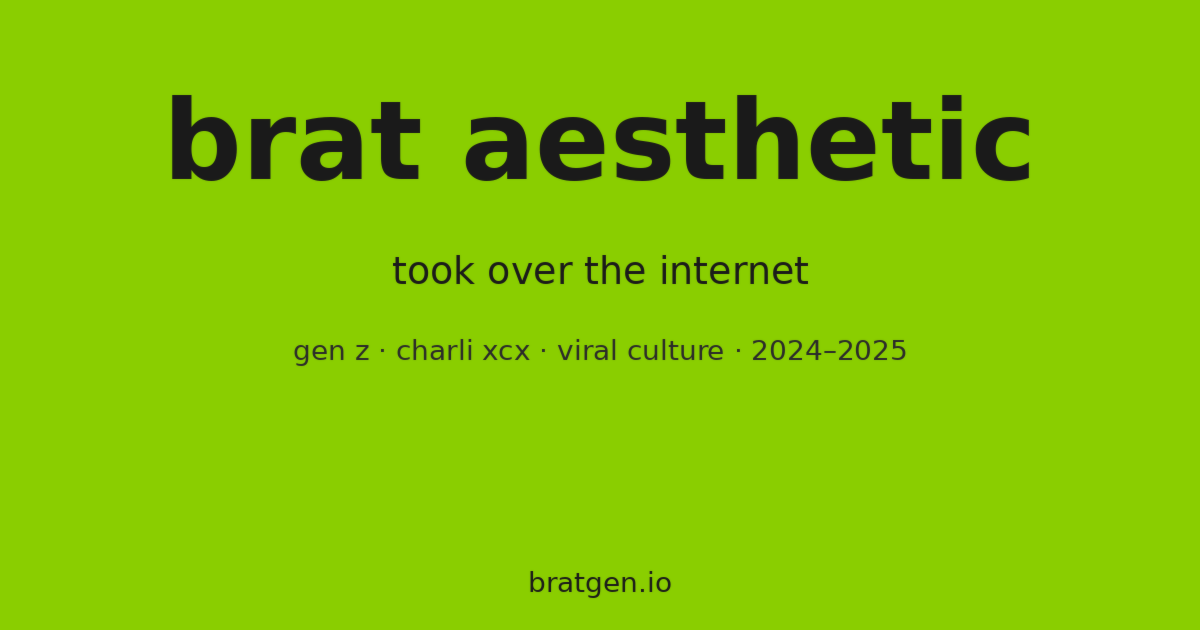
If you’ve spent any time on social media in the past couple of years, you’ve seen it — that unmistakable neon green, the smudged lowercase typography, the deliberately imperfect energy. The brat aesthetic didn’t just go viral; it rewired how a generation expresses itself online. And the story behind how it got here is more fascinating than most people realize.
This isn’t just about an album cover. It’s about a cultural moment that collided with a generation hungry for something raw, unpolished, and unapologetically loud.
Where It All Started: Charli XCX and the Album That Redefined Cool
In June 2024, British pop star Charli XCX dropped her sixth studio album simply titled brat. The cover — a blurred lime green background with a lowercase font that looked almost deliberately amateurish — became one of the most instantly recognizable visuals in recent pop culture history.
The word “brat” in Charli’s universe meant something specific: messy, confident, a little chaotic, and completely unbothered by perfection. It was an identity, not just a vibe. Almost immediately, fans started replicating it — green profile pictures, blurry text graphics, the whole vocabulary.
What happened next is what separates a regular album rollout from a genuine cultural phenomenon. The aesthetic became a meme, a political symbol (when Kamala Harris’s campaign adopted it briefly), a fashion sensibility, and a visual language that spread from TikTok to Twitter to Instagram at unprecedented speed.
Why Gen Z Grabbed On and Wouldn’t Let Go
Every generation finds its visual shorthand — the aesthetic that signals “I’m one of you.” For millennials, it was minimalism and rose gold. For Gen Z, brat hit differently because it felt like a rejection of those polished, aspirational aesthetics.
Psychologists and media researchers have noted that Gen Z has grown up watching hyper-curated Instagram feeds and picture-perfect influencer content, and there’s a growing fatigue with it. The brat aesthetic flips the script: the smudged font, the oversaturated green, the intentional imperfection — it says that trying too hard is cringe, and authenticity (even manufactured authenticity) is what counts.
There’s also a playfulness to it that’s hard to resist. The brat identity has humor built in. It doesn’t take itself entirely seriously, which paradoxically makes it more compelling to participate in.
The Internet Machine: How a Visual Trend Becomes a Movement
The mechanics of how brat spread online are a masterclass in modern virality. A few key factors came together:
First, the aesthetic was remarkably easy to replicate. You don’t need Photoshop skills or a design background. A green background, a blurry font, a few words — done. This low barrier to entry is crucial for any trend that wants to achieve mass participation.
Second, tools emerged that made participation even simpler. Browser-based generators let anyone create their own brat-style graphics in seconds. Sites like bratgen.io became central to the trend’s spread, giving fans an instant way to produce personalized brat-aesthetic images without any design knowledge whatsoever. The brat font generator specifically — which replicates that iconic blurred, lowercase style — became a go-to for memes, birthday posts, announcements, and everything in between.
Third, the aesthetic crossed over into real-world contexts. Political campaigns, sports teams, brands, and celebrities all tried their hand at brat-ifying their content. Each crossover event sent another wave of people back to search for the visual tools to participate.
Breaking Down the Brat Visual Language
If you want to understand why the aesthetic works, it helps to look at what’s actually going on visually:
- The specific shade of lime green (#8ACE00 in the original, though variations abound) is key. It’s not a comfortable color — it’s aggressive, almost garish, which is exactly the point. It demands attention.
- The typography — lowercase, slightly out of focus, using a sans-serif font — communicates informality and speed, like a text message rather than a billboard.
- The overall composition is deliberately sparse. No gradients, no drop shadows, no complicated layouts. Just color, text, and attitude.
- These design choices aren’t accidents. They’re a coherent visual statement about what the brat identity values: directness over decoration, feeling over polish, presence over perfection.
Celebrities Who Leaned In (and What It Did for Their Image)
One of the most interesting dimensions of the brat moment has been watching which celebrities embraced it and why. Beyond Charli herself, the aesthetic was adopted by a range of figures:
When Kamala Harris’s 2024 presidential campaign briefly adopted brat imagery, it generated a moment of genuine crossover between pop culture and politics that felt almost surreal — a testament to how deeply the aesthetic had penetrated mainstream consciousness.
British artist Lorde, pop acts like Billie Eilish, and various reality TV personalities have all posted brat-adjacent content. For many of them, the appeal is the same: it signals cultural fluency with Gen Z without requiring them to do much more than use the right color and lose the capital letters.
For brands, the calculus is slightly different. A few pulled it off. Most didn’t. The brands that succeeded understood that the brat aesthetic has an anti-corporate DNA — it works best when it feels spontaneous, not when it’s clearly the output of a marketing committee.
Is Brat Still Relevant in 2025 and Beyond?
Every trend eventually crests and recedes. The question for brat is whether it has enough staying power to become a genuine, lasting aesthetic category — or whether it’s already fading into nostalgia.
The honest answer is: it’s somewhere in between. The peak virality of summer 2024 has passed, but the visual language brat introduced has embedded itself more permanently into digital culture. The lime green, the smudged text, the lowercase energy — these feel less like a trend now and more like an established aesthetic shorthand that creators will keep reaching for.
Think of it like how lo-fi aesthetics from the early 2010s or vaporwave visuals from the mid-2010s never fully disappeared — they became part of the creative vocabulary that designers and content creators draw from. Brat is on that trajectory.
For anyone who wants to participate in or experiment with the aesthetic — whether you’re a content creator, a social media manager, or someone who just wants to make a fun birthday graphic — the tools are more accessible than ever. Free browser-based generators mean you can produce authentic-looking brat-aesthetic visuals in under a minute, with no software to download and no design skills required.
The Bigger Picture
What the brat moment really tells us is something about how aesthetics function in the age of participatory internet culture. A visual language spreads not just because it looks good, but because it’s easy to join, easy to remix, and easy to make your own.
Charli XCX gave Gen Z a starting point. The internet — and the tools that emerged around it — did the rest. The result is one of the most cohesive and instantly recognizable visual identities to emerge from pop culture in years.
Whether you love it, find it exhausting, or just want to use it for a meme, brat’s impact on internet aesthetics is impossible to ignore. And if you want to make your own? You’re one browser tab away.
